
The blessed restraint
A fable of comfort, control, and collective denial

A book
The post office box for the Leading Edge Clinic is in downtown Ithaca. It’s staffed by a small cast of characters who have been there for years, and manage to keep up a high level of customer service and clever banter of which I don’t tire. If you lived in Ithaca for twenty five years, and saw the freaks, geeks and human folly that is on daily parade around you, you would deeply appreciate the intestinal fortitude and strength of spirit which they demonstrate. I try to get in and out as quickly as possible, parking in the two minute space when available.
Several weeks ago, the box was overflowing. Ugh. Wasn’t I here a week prior? Apparently not, because there were three keys and two package notices jammed into the box with the junk mail. I approached the counter with a sheepish apology, and a pile of packages in my arms. “I’m really sorry guys, I didn’t know that I was taking up so much of your package box real estate.” The bearded post office super hero looked at the package notice and said out loud, “Oh, box 57290 (not really our box, but anyway).” He looked at the post office super hero next to him, the one with the day’s growth of beard and sandy blond hair which would have made him seem right at home in some Jammers swim trunks holding a surf board. They exchanged a knowing look and nod of their heads, and I realized that Box 57290 was a frequent topic of discussion among them. Oh man, I gotta make sure this doesn’t happen again.
When I got home with my pile of packages and envelopes, I started going through everything. There were hard copies of labs from Quest and LabCorp. I’m not sure why they send these, because we already have the results sent to us electronically. There were bank statements: ditto. There was a fund raising letter for my dear departed friend Bob Nape, who was the owner/occupant of our PO Box before us. There was a letter from a Christian medical freedom organization asking Pierre to join their ranks. A supplement manufacturer had sent a pile of samples, no thanks. A compounding pharmacy that we had used once sent a thick envelope with an updated catalogue. And finally, there was a book. It was in a dark black box, with a dark cover, wrapped in black tissue paper (I was intrigued), and addressed to Pierre. It was titled Vaccines, Amen and written by none other than Aaron Siri.
Who is Aaron Siri? He is an American attorney and the managing partner of Siri & Glimstad LLP, a national firm specializing in civil rights, class actions, and vaccine injury litigation. He gained national attention during his September 2025 testimony before the U.S. Senate Subcommittee on Investigations, where his appearance in the hearing titled “How the Corruption of Science Has Impacted Public Perception and Policies Regarding Vaccines” sparked widespread controversy after he presented an “unpublished” study comparing chronic illness rates in vaccinated and unvaccinated children.
What is his book about? “Vaccines, Amen: The Religion of Vaccines” (2025) argues that vaccine policy in the U.S. has become a belief system rooted in faith rather than open scientific inquiry. Drawing from his legal experience, Siri contends that industry, media, and government agencies align to suppress debate and protect pharmaceutical interests, undermining informed consent and public accountability.
I texted Pierre with a photo of the book and packaging.
Me: Aaron Siri sent a book to the PO Box in Ithaca. Shall I forward that to you?
PK: No, he sent me one, if it’s vaccines amen. It’s yours, it’s actually a phenomenal book, like mind blowing eye opening.
Cool. I get to keep this dark book, with the black tissue paper in the black box.
I read the first chapter the next morning while I pet our tawny cat, and devoured my toast with strawberry Bonne Maman jam, eggs and bacon. It seemed like any other rushed morning before work. Wrong. I was stunned. This keeps happening. I think that I/we know a lot about vaccines and vaccine injury, because A) I’m injured by the Pfizer shots B) my wife is injured by the Moderna shots C) I co-own a telemedicine practice which treats post-acute sequelae of Covid (PASC) and vaccine injury and D) I finally woke up in 2021 to the true extent of evil in our healthcare system. Well, Aaron knows more about the scams and schemes of vaccinology in his little pinky finger than I know in my whole being. That’s okay though, because I’m curious and like to learn.
I’m loving Aaron’s book. As a clinician who treats PASC and injury from the Covid shots every day of the week, and then faces the upside down worldview of my community that vaccines are safe and effective, well, it’s refreshing to hear what the lawyers have to say. As Aaron says, paraphrasing here, because he isn’t a doctor, he can’t just tell you to trust him. He actually has to learn and use the facts, because in a court of law, the facts are what (at least should) matter.
God bless Nebraska
There was a powerful moment early in the pandemic illustrating how the legal eagles were better at parsing facts than system doctors, pharmacists and public health officials. In October 2021, the office of Nebraska Attorney General Douglas Petersen released a formal opinion titled “Prescription of Ivermectin or Hydroxychloroquine as Off-Label Medicines for the Prevention or Treatment of COVID-19.” The report examined legal and medical literature regarding these drugs and concluded that Nebraska physicians who prescribed them off‑label, with informed consent and no misconduct, would not violate state law. This deeply researched and illuminating document came into existence because the CEO of the Nebraska Department of Health and Human Services has requested the Attorney General’s opinion.
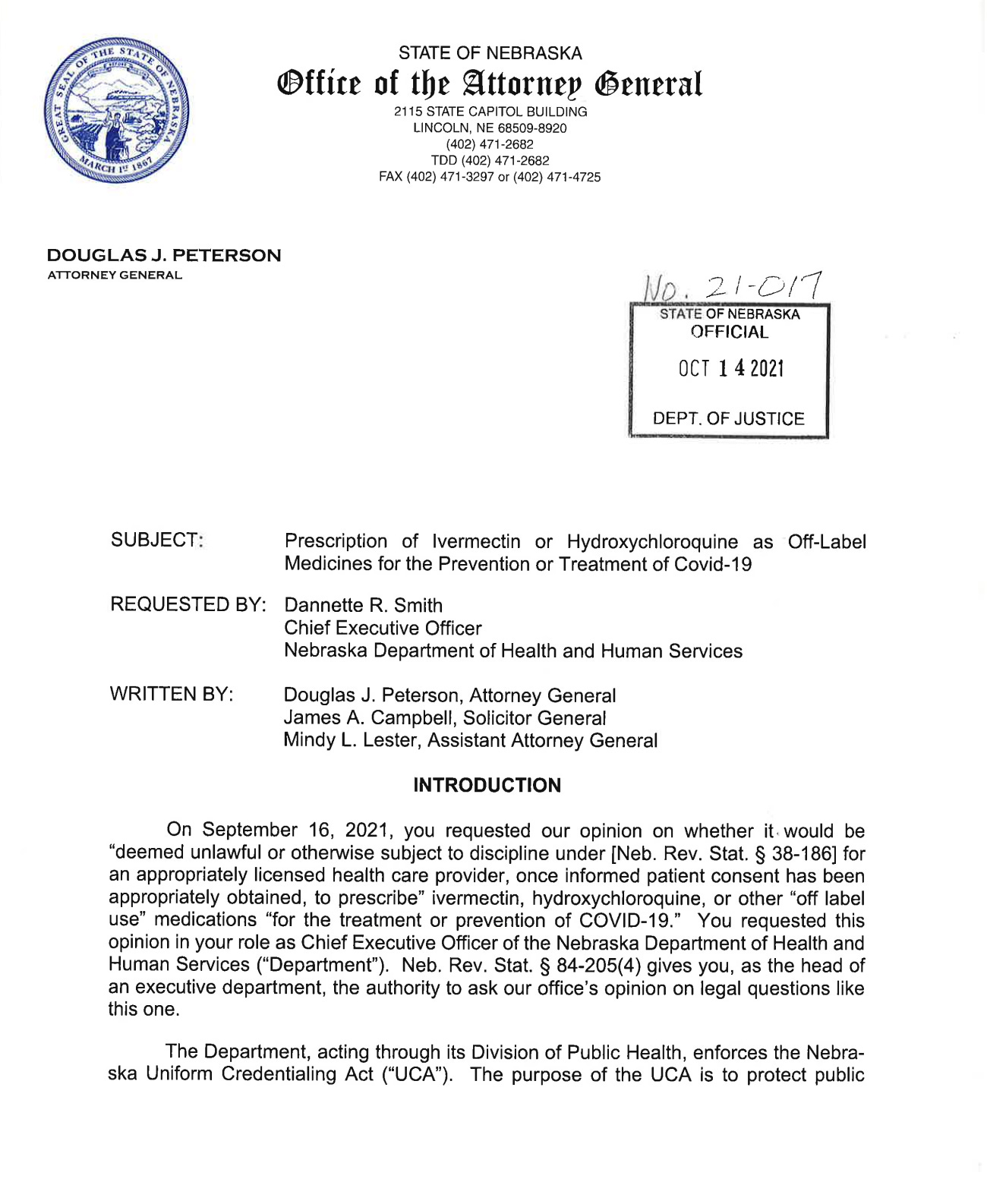
It’s not easy or simple to convey to Lightning Bug readers what a source of reassurance and strength that report was for me. I’m glad that I have an HP Instant Ink subscription, because I printed that report off at least six times. I kept one of those copies on the side board where I could see it every day on my way to work. It helped remind me that in a world which seemed to have lost its collective mind, there was still some vestige of sanity, rationality and scientific integrity. Instead of coming from physicians and scientists, it came from lawyers. Go figure.
I tried sharing that report with doctors, NPs, local public health officials, family, friends, neighbors. Consistent with the believers of the Vaccines, Amen! crowd Aaron writes about, they were having none of it. Of course, my reading of the document focused on how the legal review of the evidence of both the safety and clinical benefit of Ivermectin and Hydroxychloroquine, contrary to the tsunami of bullshit propaganda in the media, was on balance, quite encouraging. That noted, Nebraska AG’s office tried to stick to their marching orders, and clarified these points of legality:
The Nebraska Department of Health and Human Services requested clarification on whether physicians could be disciplined for prescribing ivermectin or hydroxychloroquine off‑label for COVID‑19.
The Attorney General concluded that off‑label prescribing of FDA‑approved drugs is a legal and common practice under both federal and state law.
After reviewing scientific and medical literature, the opinion found no clear and convincing evidence that prescribing these drugs for COVID‑19 constitutes a violation of Nebraska’s Uniform Credentialing Act.
The report emphasizes doctors must obtain informed consent, clearly explaining the drugs’ off‑label status and potential risks.
It states that Nebraska’s licensing boards should not punish physicians using these drugs in good faith and with patient consent.
The opinion cites historical precedent for off‑label uses, noting that many widely accepted treatments began as off‑label applications.
It acknowledges “significant controversy and inconsistent data” surrounding COVID treatments but stresses that disagreement does not equate to illegality.
Peterson’s office reviewed FDA statements, NIH guidance, and peer‑reviewed studies, concluding that none provide sufficient basis to criminalize or penalize off‑label use.
The document clarifies that the Attorney General’s office is not recommending ivermectin or hydroxychloroquine—only affirming physicians’ freedom to prescribe them.
The opinion asserts enforcement would only be warranted in cases of gross negligence, misconduct, or lack of consent, not for differing medical judgment.
All I ever wanted, and all any other prescribing physicians, NPs, or PAs wanted during the whole pandemic, was for the government to keep its dirty mitts off my freedom to treat the patient in front of me with the tools at my disposal. If other state attorneys general, and our federal government, had acted rationally, and in the interest of the citizens who pay for its functions with our taxes, prescribing Ivermectin and Hydroxychloroquine would have been a moot point. The problem was that if there were currently available and safe therapies to treat acute Covid, which there were, and IVM and HCQ were two of the best, then the Emergency Use Authorization (EUA) would not have been authorized to approve the minimally tested Covid shots.
Which brings me back to Aaron Siri and his book. I think the most important message that I have absorbed from Aaron’s book is this: vaccines are a commercial product made by for-profit companies, and there is no other product in the world, which is completely shielded from legal liability like vaccines are in the United States. Right there was planted the seed for this Substack. What, I thought, if I wrote about another fixture of childhood and parental attention? What if it was something which like vaccines, was widely used and intended to protect children from injury and death, but unlike vaccines, it’s manufacturers are currently compelled to make it safe, because if they don’t, they can be sued, even imprisoned? And then, I would change the scenario, and shield this product. This satirical allegory is what followed.
Over the hill and through the woods to grandmother’s house we go….
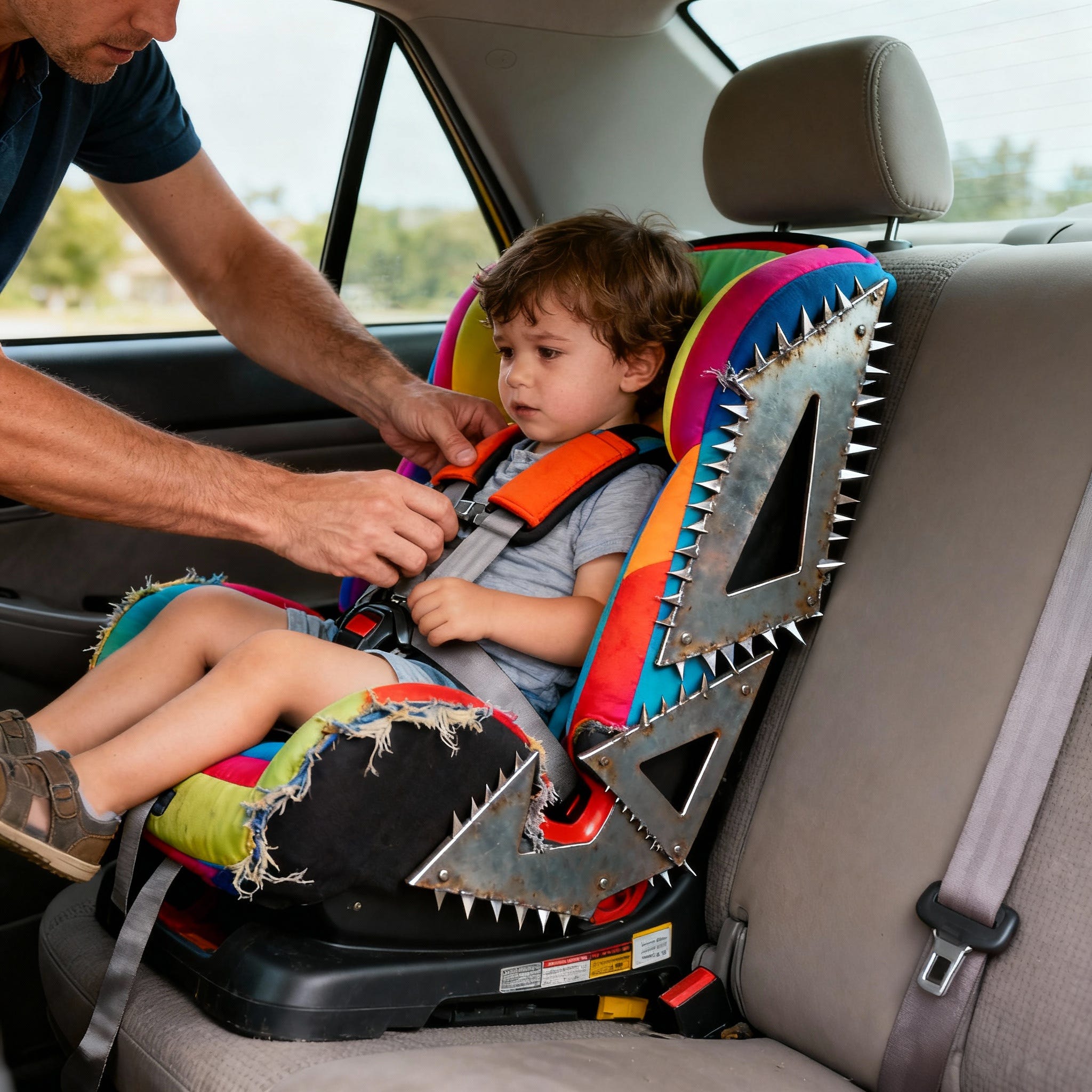
In an alternate America, infant and child car seats have ascended to a sacred status. They are not merely safety devices — they are cultural commandments. Each new parent leaves the hospital not only with a newborn swaddled in hope, but also a sleek, brightly colored car seat embossed with smiling cartoon creatures and glossy consumer labels. The seats shine in pastel glory — yet inside, their frames are riddled with sharp metal points, their latches prone to sudden failure, their fabric covers hiding defective design that any rational eye could see.
But questioning this is heresy. The Car Seat Safety Act of 1986 ensures that manufacturers, no matter how negligent, can never be held liable for injuries or deaths caused by their products. Legislators called it a landmark victory for innovation. Parents called it silence.
Each day, tragic stories flicker across quiet corners of the internet: children harmed, sometimes fatally, by these devices. Grieving parents seek justice but find only locked courtroom doors. The very agency meant to protect consumers — the Department of Household Safety (DHS) — doubles as the industry’s chief marketing arm, producing cheerful campaigns that equate “safe driving” with “faith in the car seat.” The department even defends manufacturers in court, arguing that the cause of each tragedy was “driver error,” “misuse,” or “rare coincidence.”
Television hosts and influencers echo the gospel: “Car seats save lives!” They repeat it with such relentless rhythm that few dare to ask how one can be sure when no liability exists, no challenge is permitted, and no injured family is ever allowed to question the doctrine.
When independent engineers attempt to publish studies revealing the flaws, journals refuse. “We cannot promote distrust,” editors explain. Meanwhile, the DHS funds endless research to prove how safe and effective the seats are — at least according to industry-approved metrics. Every few years, old officials depart government agencies and emerge weeks later as well-paid “safety consultants” for the same companies they once regulated.
Despite the steady stream of comforting statistics, there’s another set of data hiding in the corners—studies that quietly disappear, like gum stuck under a seat. For every report celebrating restraint as our savior, there are crash files and field notes that tell a rougher story, one where safety and faith blur into the same line on a graph. And as any good custodian of public confidence knows, inconvenient evidence has to be guided out of sight before it shakes the sermon.
People still whisper about the ones who spoke up—the researchers who asked the wrong questions and found their work labeled “unhelpful” or “confusing.” One even mapped out thousands of accidents and learned that the “approved cushioning” might do more as a moral symbol than an actual guardrail. But those numbers got filed away in government annexes, marked as anomalies, and the official story rolled on—verified by experts, smoothed by consensus, padded for comfort.
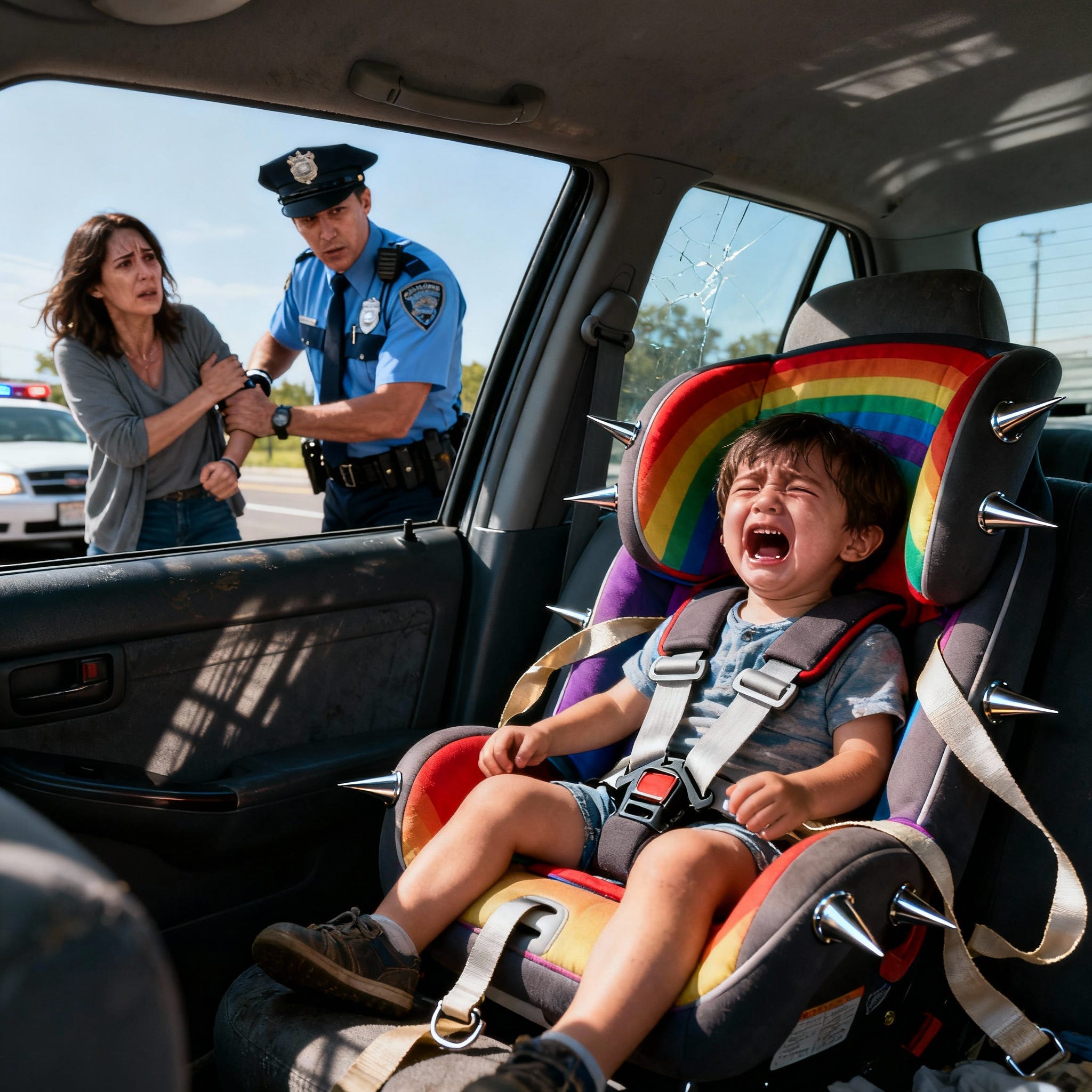
The obedient majority scoffs at dissenters. Police routinely stop parents who refuse to strap their children into these contraptions. The fines are heavy; repeat offenders face arrest. Pediatric offices post warning signs: “Car-Seat Refusers Will Be Discharged.” Neighbors gossip . Strangers glare in parking lots.
Consumer magazines glow with staged photos of happy infants buckled into their shoddy thrones, clutching foam dinosaurs and pastel rattles. The expert review sections note “no significant safety issues.” Meanwhile, online, small communities of broken parents share quiet testimonies of harm — stories met with derision, gaslighting, or censorship.
Eventually, the drumbeat grows louder. The state of California passes the Protect the Children Act, authorizing removal of children from homes where car seats are “willfully misused or absent.” It is hailed as a triumph of public virtue. Officials speak in polished tones about “community responsibility.” Television anchors nod approvingly as handcuffed mothers are led from their cars, a crying child visible through the window, strapped into a seat that never truly was safe.
And in this strange America, people drive past the scene without a thought — because the message has been drilled so deep: if you question the seat, you endanger us all. Better a thousand dead children than a single doubt in the sacred science of safety.
PS This Substack story is fictional, satire and allegory, not intended to undermine the genuine safety and protective role of properly installed and utilized infant car seats. Even with car seats there is conflicting or mitigating, nuanced data. Car seats are big business, but the manufacturers of car seats, unlike vaccine manufacturers, have legal liability, and thus are motivated to make their products as safe as possible within their parameters of profitability.
See below from Perplexity AI.
There are some engineering safety studies and analyses that challenge the universal superiority of car seats over seat belts, particularly for children aged two and above, though these findings are controversial and disputed by safety experts.[1][2][3]
Critical Studies and Controversies
A prominent analysis by economist Steven Levitt (and reflected in “SuperFreakonomics”) directly compared the effectiveness of car seats and seat belts for children using U.S. fatality data, concluding that for ages two and up, there was no significant difference in fatality reduction between properly used car seats and seat belts. When controlling for crash type and restraint usage, the differences in injury prevention largely disappear. These results remain robust across various sensitivity analyses and crash types.[2][3][1]
Similarly, a scientific journal retracted a widely cited study asserting that rear-facing seats are five times safer than forward-facing ones for one- to two-year-olds, acknowledging that the supporting data were improperly handled and could not substantiate this claim. Subsequent analyses found the evidence insufficient to distinguish injury rates based on seat orientation for that age group.[4]
Safety Experts’ Counterarguments
Safety professionals and pediatricians strongly object to these conclusions, noting that the studies focusing on fatal crashes may miss the broader picture of injury prevention or understate the benefits of car seats in nonfatal accidents and side impacts. Most other analyses, especially those that combine multiple crash databases, demonstrate that car seats provide a significant reduction in serious injury and fatality for young children, particularly when correctly installed and used as intended, with estimates ranging from 21% to 82% risk reduction depending on proper use and data source.[5][6][1][2]
Key Factors and Misuse Issues
A major confounding factor is improper installation or use: between 60% and 80% of car seats are not used correctly, severely compromising their protective value. Some studies suggest that the protective advantage of car seats over seat belts is most apparent when seats are properly installed; otherwise, their benefits are greatly diminished.[3][7][8][9]
Summary Table
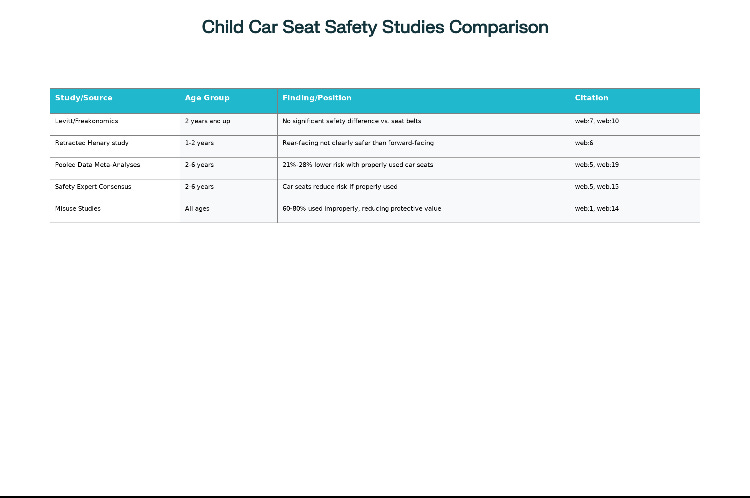
Conclusion
There is evidence from engineering and economic studies that challenges the extent of car seat safety benefit, especially for older children, but the majority of real-world studies and expert opinions continue to support their use, provided seats are properly installed and used.[6][9][1][2][3]
Sources
[1] Child Passenger Safety | Pediatrics - AAP Publications https://publications.aap.org/pediatrics/article/127/4/e1050/65110/Child-Passenger-Safety
[2] Are Your Kids Really Safer in Car Seats? - ABC News https://abcnews.go.com/GMA/Parenting/child-safety-car-seats/story?id=8867880
[3] [PDF] Evidence that Seat Belts are as Effective as Child Safety Seats in ... https://pricetheory.uchicago.edu/levitt/Papers/levitt_carseats_farsdata.pdf
[4] Researchers admit “5X safer” claim for rear-facing car seats is false https://www.babybargains.com/bombshell-researchers-admit-5x-safer-claim-rear-facing-car-seats-false/
[5] FREAKONOMICS Fallacy: An Economist or a Pediatrician - Who ... https://thecarseatlady.com/freakonomics-fallacy-an-economist-or-a-pediatrician-who-would-you-trust-to-keep-your-child-safe/
[6] Everything You Ever Wanted to Know About #%!@% Car Seats https://slate.com/human-interest/2013/10/car-seats-from-rear-facing-to-forward-facing-to-booster-everything-you-need-to-know-about-these-infuriating-to-install-life-saving-contraptions.html
[7] Sixty percent of car seats are used improperly. Better data keeps ... https://hscweb3.hsc.usf.edu/health/publichealth/news/sixty-percent-of-car-seats-are-used-improperly-better-data-keeps-kids-safer/
[8] Study shows almost 50% misuse of car seats - BeSafe https://www.besafe.com/en/safety-tips/safety-education/child-car-seat-misuse-study/
[9] Child Car And Booster Seat Use Riddled With Problems, New ... https://www.forbes.com/sites/tanyamohn/2024/09/29/child-car-and-booster-seat-use-riddled-with-problems-new-report-finds/
[10] The importance of child car seats and current challenges with their use https://pmc.ncbi.nlm.nih.gov/articles/PMC3496348/
[11] Car Seat Safety Starts at Birth — and Shouldn’t End Too Soon https://newsroom.aaa.com/2025/09/car-seat-safety-starts-at-birth-and-shouldnt-end-too-soon/
[12] Controversy about Safety Seat Testing - Carseat.org https://carseat.org/controversy-about-safety-seat-testing/
[13] Car Seat Inspection Among Children Older Than Three - NIH https://pmc.ncbi.nlm.nih.gov/articles/PMC4551077/
[14] Car seat safety: Typologies of protective health and safety behaviors ... https://pmc.ncbi.nlm.nih.gov/articles/PMC5247407/
[15] Child Passenger Safety: An Evidence-Based Review https://www.east.org/education-resources/practice-management-guidelines/details/child-passenger-safety--an-evidence-based-review
[16] How Much Do We Really Care About Children? - Freakonomics https://freakonomics.com/podcast/how-much-do-we-really-care-about-children-ep-447/
[17] Rear-facing child safety seat effectiveness: evidence from motor ... https://pubmed.ncbi.nlm.nih.gov/36918272/
[18] Preventing Child Passenger Injury - CDC https://www.cdc.gov/child-passenger-safety/prevention/index.html
[19] Are car seats ineffective after two? : r/ScienceBasedParenting - Reddit https://www.reddit.com/r/ScienceBasedParenting/comments/1g3l2no/are_car_seats_ineffective_after_two/
[20] Use of child safety seats and booster seats in the United States: A ... https://www.sciencedirect.com/science/article/abs/pii/S0022437521001092
"Aaron Siri ... his September 2025 testimony before the U.S. Senate ... he presented an “unpublished” [Henry Ford] study comparing chronic illness rates in vaccinated and unvaccinated children."
. .. .
I highly recommend ICAN's The HighWire new documentary "An Inconvenient Study" about that 2020 Henry Ford Study. aninconvenientstudy.com
Siri's Sept 9th written Senate testimony walks the reader through the study (adapted from CH 12 of his book "Vaccines, Amen"). https://www.hsgac.senate.gov/wp-content/uploads/Siri-Testimony-1.pdf
You can also read/download a pdf of the entire study at: https://www.hsgac.senate.gov/wp-content/uploads/Entered-into-hearing-record-Impact-of-Childhood-Vaccination-on-Short-and-Long-Term-Chronic-Health-Outcomes-in-Children-A-Birth-Cohort-Study.pdf
Excellent analogy.